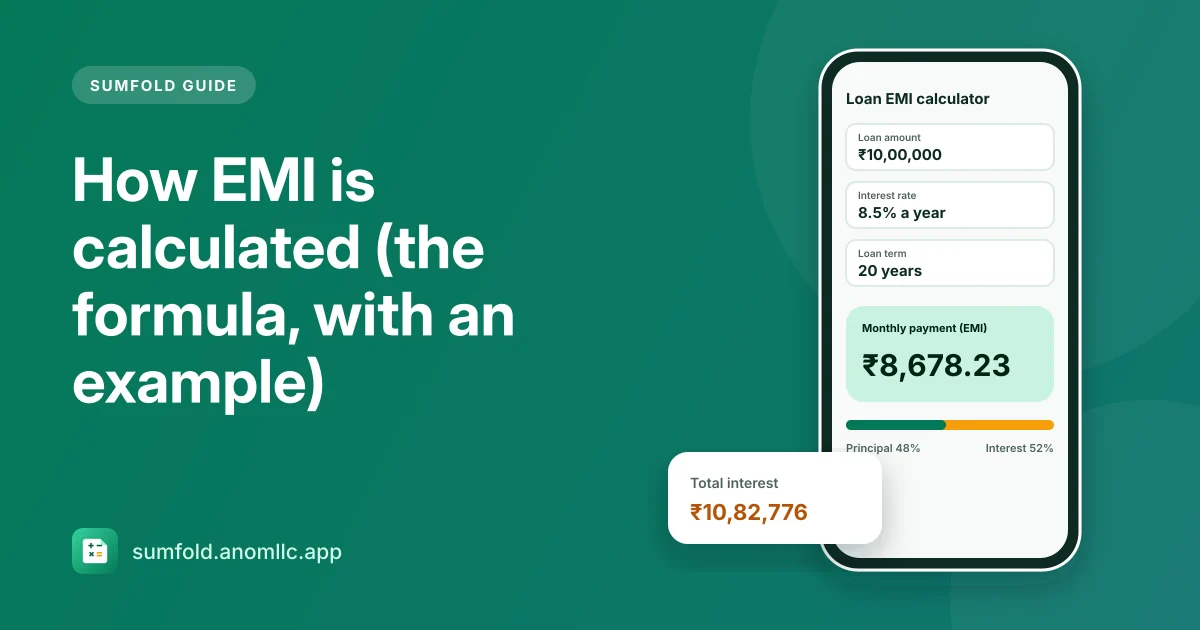
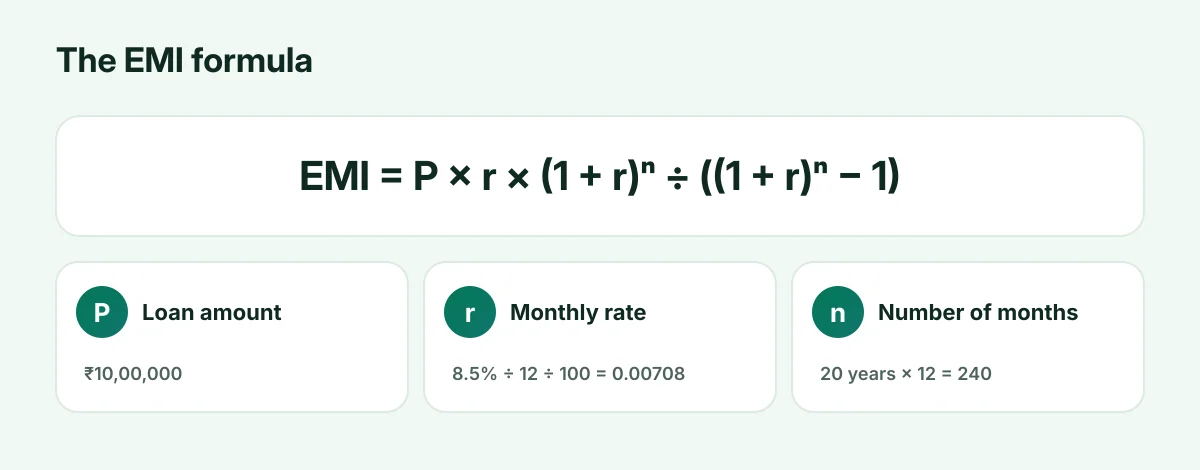
An EMI (equated monthly instalment) is the same payment every month that pays off a loan and its interest by the end of the term. Banks work it out with one formula: EMI = P × r × (1 + r)ⁿ ÷ ((1 + r)ⁿ − 1), where P is the loan amount, r is the monthly interest rate and n is the number of monthly payments. For a ₹10 lakh loan at 8.5% a year for 20 years, that comes to ₹8,678 a month.
The three numbers in the formula
- P, the loan amount (principal). What you borrow: ₹10,00,000 in our example.
- r, the monthly interest rate. Divide the yearly rate by 12 and by 100. For 8.5% a year: 8.5 ÷ 12 ÷ 100 = 0.0070833.
- n, the number of months. Years × 12. For 20 years: 240.
A worked example: ₹10 lakh at 8.5% for 20 years
- Work out (1 + r)ⁿ. (1.0070833)²⁴⁰ ≈ 5.4412.
- Top of the formula: P × r × (1 + r)ⁿ = 10,00,000 × 0.0070833 × 5.4412 ≈ 38,542.
- Bottom of the formula: (1 + r)ⁿ − 1 = 5.4412 − 1 = 4.4412.
- Divide: 38,542 ÷ 4.4412 ≈ ₹8,678 a month (₹8,678.23 if you keep every decimal).
Over 240 months you pay 8,678.23 × 240 = ₹20,82,776 in total, of which ₹10,82,776 is interest, a little more than the loan itself.
Why your first payments are mostly interest
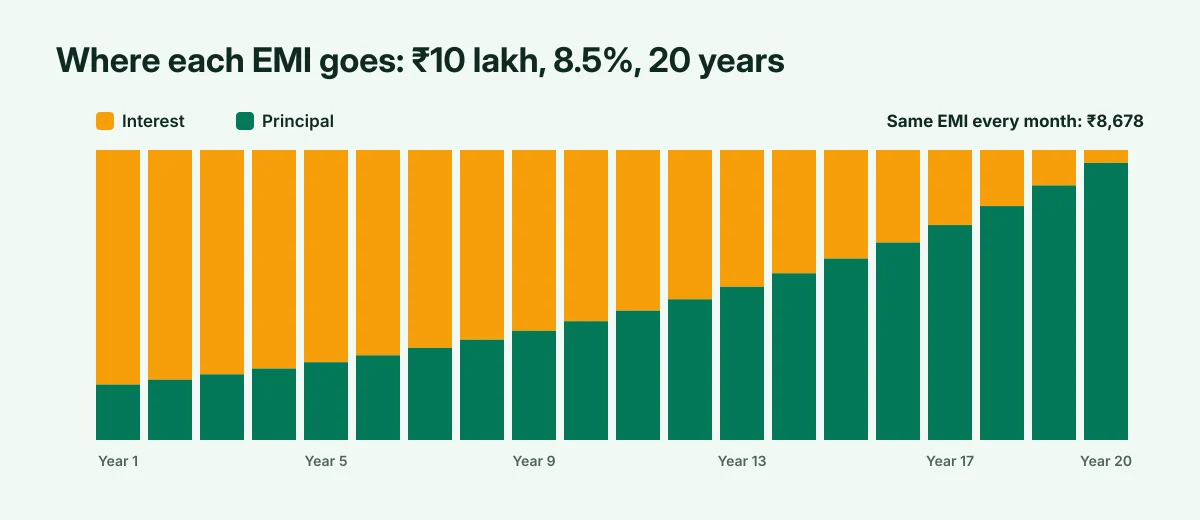
Each month, interest is charged on what you still owe. In the first month that's the whole ₹10 lakh: 10,00,000 × 0.0070833 = ₹7,083 of interest, so only ₹1,595 of your ₹8,678 payment reduces the loan. As the balance falls, the interest part shrinks and the principal part grows, until the last payments are almost all principal. This is called a reducing-balance loan, and it's how almost all home, car and personal loans work.
Check your EMI in seconds (Sumfold)
Doing the powers by hand is slow. In Sumfold:
- Open the Loan EMI tab.
- Enter the loan amount, the interest rate a year and the term in years or months.
- Read the monthly EMI, the total interest and the total you'll pay. Tap Payment schedule to see each year's principal, interest and remaining balance, and tap a year to see its months.
Why your bank's figure may differ a little
Your lender's EMI can be a rupee or two different because of rounding. A bigger difference usually means something else is included: a different start date (interest for the first broken month), processing fees or insurance added to the loan, or a floating rate that has changed. Ask the lender for the amortisation schedule if the numbers don't match.
Ways to pay less interest
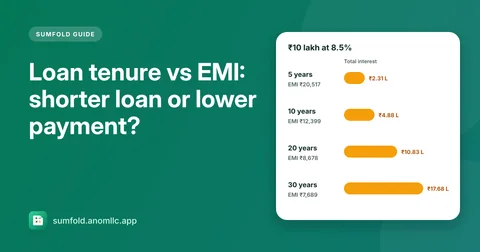
- A shorter term raises the EMI but cuts the total interest sharply. See our guide on loan tenure vs EMI.
- Part-prepayments early in the loan, when most of each payment is interest, save the most.
- A lower rate matters more the longer the loan: 0.5% less on a 20-year loan is worth comparing lenders for.